Sunday, September 6, 2015

Keep Calm and Enjoy Classic Learning


Image result for learning enjoy

When we were asked to make a list of “learnings we enjoyed” last Thursday, I wasn’t sure that I completed the task correctly. As the instructions were being given, I figured my list would contain concepts and facts and ideas learned in school. What I ended up with was a more personal list of skills I have developed and understandings I have come to about myself and the world (for example, how to do research, how to plan and execute a fun camping trip, and realizing I don’t have to agree with and follow everything my parents do).

As I read this brief section of The Book of Knowing and Forgetting by Frank Smith, I realized that what I had listed were all examples of classic learning. The skills and understandings fit the criteria on page 5, in that they are continual (for example, I am continually learning how to be a better researcher), inconspicuous (after all my years of camping as a kid, I didn’t realize how much I had picked up about what supplies are necessary and what makes the best site), and associated with growth (for example, I have a much more critical view toward the institution of religion my parents raised me in). And Smith’s idea that “we learn from people around us with whom we identify” was made obvious by the names listed in the margin of Wednesday’s notebook entry. The names are all of people that I would quickly identify as having a major positive influence on my life.


Absent from my list were things that I have learned “officially” - all 50 states and capitals, how to multiply fractions, and the chemical formula for sugar. Discrete knowledge and skills like these were not really enjoyable (aside from the reward of getting a good grade on a test). As official learning theory says, these learnings were hard work, intentional, individualistic, assured by testing, and intellectual activities that required memorization. And aside from multiplying fractions, which I do when I cook or bake, it takes great effort to recall all those states, capitals, and elements from the periodic table.

Image result for lisa delpit

While reading, I was curious about what Lisa Delpit might say in conversation with Smith, considering her belief in the importance of intentional teaching about the culture of power and code-switching. (From the lists on page 5, intentionality is associated with official learning.) But with further thought, realized just how much her philosophy aligns with Smith. They both recognize that learning is taking place all the time - especially “things that we might be better off not learning, such as the fact that there are certain things we should expect to be able to learn, or that we have certain (usually fictitious) learning deficiencies or disabilities” (3). Delpit would say that in the case of students of color or students with diverse linguistic backgrounds, every time a teacher punishes a student for their word choice or bleeds red ink correcting every punctuation and grammar mistake on an essay, those students are learning that they are not normal, wrong, and inferior (when it is not actually a matter or "right" or "wrong," just "different). So although certain intentional teaching about the codes of power must exist, Delpit and Smith would agree that it must be done in the context of learning from the people around them. Students cannot memorize a formula for code switching. Traditional pen and paper testing will not prove their understanding of the way power is enacted in the world around them. See Delpit's Rethinking Schools article "The Real Ebonics Debate" for even more about how teachers might approach classic and official learning of language.

Image result for language learner comics
 
Though my students are not very racially or linguistically diverse, they do vary in gender identity, socioeconomic status, family structure, learning style, academic readiness, and extra-curricular interests. I need to keep in mind that these students are always learning something - and it may or may not be the academic content or skills that are listed in my objectives on the board. Whether it is the texts I use, the attitude I take toward certain topics, the way I interact with different students, the time I give to particular conversations, or the order in which I explain the requirements and grading of an assignment, the students are learning something about what is “normal,” what is valued, and whether or not they fit in with that. I will continue to incorporate open-ended reflection questions at the end of individual lessons and longer units of study as a way to check what else I am teaching and the (not so) hidden curriculum that is being learned.

Friday, July 10, 2015

Once Upon a Time: The Final Reflection

Once Upon a Time

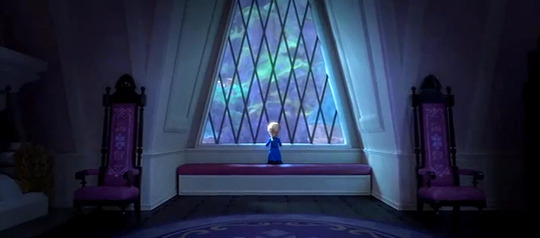
Once upon a time I was a first year Language Arts teacher in Coventry. I taught seventh grade and really tried my best, but struggled to find the joy that I had been cultivating through college. Like Elsa hidden away in a castle, I felt isolated in my classroom and needed to be saved.

But not by a knight in shining armor.

Unless by “knight in shining armor” you mean a new job and enrollment in the Advanced Studies in Teaching and Learning program at RIC.

With a cohort of professors to push me and critically-minded classmates to support  me, I transitioned more smoothly to life as a sixth grade Language Arts teacher in Jamestown. Rather than feeling isolated in my castle, I felt free to roam with my new colleagues in the luscious gardens of social justice teaching and action research.

Now that the year has ended - and I will remain in Jamestown as the sixth grade Language Arts teacher with the same curriculum - I have a list of ideas as long as Rapunzel’s hair about what I want to keep, throw away, and revise.


Not A Princess, Not Quite a Techno-Constructivist

I came into this class rather unlike a princess, no longer feeling isolated in my own castle or feeling in need of saving by a prince. Instead, like Merida, I was armed with a bow and arrow to sling my social justice pedagogy. Unlike my first year in Coventry, this year in Jamestown I felt more confident in pushing back at the traditional texts and assessments demanded by the curriculum. This year I was really able to take action on my belief that everything is political. I infused a study of critical lenses, stereotypes, and power hierarchies based on traits like race, class, gender, sexuality, and social class. At my end of year survey, countless students said that our “Media Busters” unit ruined Disney movies and that because of Photovoice, they will never see the world the same again.

I also came in with greater technology proficiency than most princesses. Whereas all Cinderella can do is sew and all Snow White can do is clean up after the dwarves, I have wide variety of exposure to other tools and tasks as an assimilated digital immigrant. Before this class I had already explored TED Ed, Animoto, Storybird, and Glogster and even used some like Blogger, Google Docs/Slides/Forms, Screencastify, StoryboardThat, and Prezi with my students. They’ve appreciated the chance to “play” online when I incorporate these tools into instruction.
So part of my struggle through the class has been to ensure that I am making conscious choices about using technology and also pushing myself further. Where have I and where should I take a techno-traditionalist approach, using technology to simplify/enhance traditional classroom tasks? Where have I and where should I take a techno-constructivist approach to completely change the content and process of students’ learning?

Rapunzel’s Strand #1: Youth and New Media

Image result for biblionasiumAs I said, my list of curriculum revisions was about about long as Rapunzel’s hair - so I began by just playing around with some new tools I found on my own - specifically BiblioNasium. All year I felt that my Independent Reading program was missing something. Having students log book titles, author names, and page numbers in a file folder in a rickety cabinet screams old-school. I noticed some students reading similar books and some students stuck with no clue about what to read next. In my own personal life, Goodreads has been a godsend for this. However, I am not comfortable having my eleven-year-olds on such a vast social network. A quick Google search with the terms “Goodreads for kids” led to some reviews for BiblioNasium - which the creators say is a space for kids to “flex their reading muscles.” I watched a video overview, signed up for a teacher account, explored a student account, and created accounts for all of my incoming students. I added a BiblioNasium page to my blog, wrote an introductory note for parents and students explaining the purpose, and even used Screencastify to make my own tutorial.

This part of my project positions me somewhere between techo-traditionalist and techno-
constructivist. While initially BiblioNasium is a digital platform that brings my paper-and-pencil reading logs into the 21st century, it also goes beyond that. The ability for students to write reviews that the whole class can see, make recommendations to individuals, and explore other students’ bookshelves changes the nature of the task. I’m not sure I can still call it “Independent Reading.” Of course, the students must still read on their own, but BiblioNasium acknowledges the way that “many of today’s teens are deeply engaged with social media and are active participants in networked publics”(Boyd, 2014, p. 176). My hope is that my students will see the way in which online connections can be used productively and to enhance their learning. As Boyd (2014) continues, “Familiarity with the latest gadgets or services is often less important than possessing the critical knowledge to engage productively with networked situations, including the ability to control how personal information flows and how to look for and interpret accessible information” (p.180). As a teacher, it is my job to expose students to tools that will help them learn and be more digitally savvy citizens.  

Rapunzel’s Strand #2: Critical Pedagogy and Educational Reform

As great as BiblioNasium might be, I knew it wasn’t enough. So, I turned to the syllabus for the course anchors and guiding assumptions to see how those fit in with the remaining items on my Rapunzel-length list. As I read #2 about critical pedagogy and educational reform, I was reminded of the fun and inspiration that came from our afternoon with Kelly Reed. I believe that students need space be creative and innovative to overcome the regulation and routine of audit culture that has seeped into our schools (Hall, 2015).

images
Since most of my units are already designed with critical pedagogy principles in mind, I wanted add something new the my beginning of the year routine. I designed a curation-inspired project, which I am calling the Brown Bag Bio, as a get-to-know-you activity. While this project does not use technology, we have agreed that it is not even about the technology, it’s about the principles behind it.


The goal of this Pintrest-in-real-life activity is for students to curate objects (from the massive pile of stuff - trinkets, toys, game pieces, clothing items, accessories, memorabilia, etc.) that will be available on various counters and tables in my classroom) that represent who they are. They will then have an opportunity to share their brown bag full of objects and their related explanations with their classmates so that they can get to know one another. They will answer reflection questions based on their classmates’ presentations like, “Who do you think you’d work well with?” “Who do you want to get to know more?” and “Who do you have a question for?” And of course, then go talk to these new classmates. As Turkle (2012) explains, “We have gotten used to the idea of being in a tribe of one, loyal to our own party.” This worries both her and me. I see this activity as a way to teach patience, provide real-life listeners, look up, start a conversation, and build a community of learners.

Media as Ideology

To complete my climb up Rapunzel’s braid, I wanted to use what I have learned about media as ideology. Though I didn’t name it as such, this assumption grounds my “Media Busters” unit where students learn to use critical lenses to analyze the messages about race, class, and gender being sent to them via commercials, movies, toys, and other media. Both during and after that unit students emailed me randomly about sexist messages they saw in commercials or (on a more positive note) provide links to spoken word poems about changing the world, one word at a time. I would try to share this information with the rest of my students either by mentioning it or screening it in class, but didn’t always have the time. These cultural artifacts were some of the best proof that they were wearing the critical lenses we tried on in class; they were the best proof of their learning. However, I felt like some of these learnings remained locked in the dungeon of my overflowing inbox. Because of this, I knew that some component of my final project for this class would be creating a space to share these connections more widely and easily.
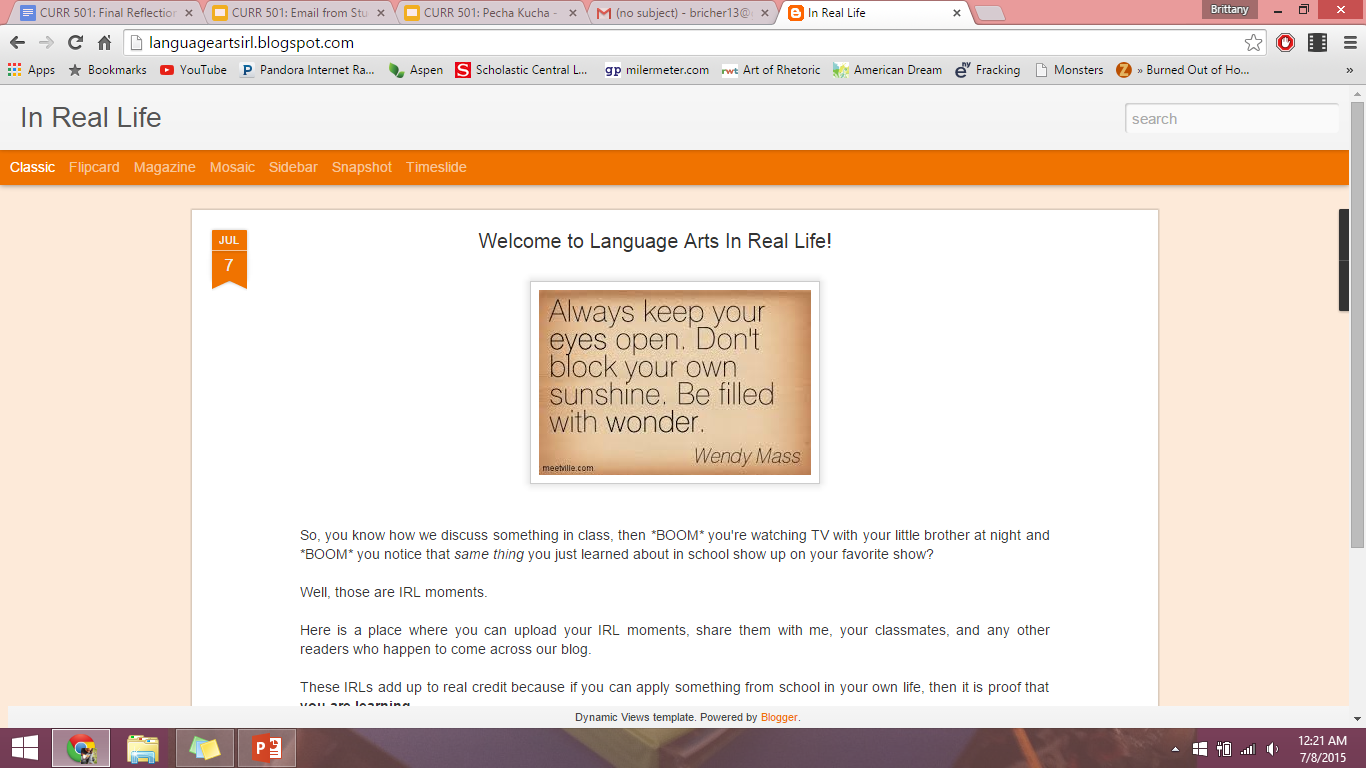
To do this, I have created a second blog with a separate email address that the students can email their IRL (In Real Life) examples to and they will automatically be posted to the home page. This blog feed will also appear on my current blog so that everything is essentially housed in one place. I wouldn’t have thought of such a possibility before this class.


Censoring all negative and potentially dangerous content from children is not the answer. As Christensen (2011) says, if we want students to “unlearn the myths that bind us,” then we must give space - especially digital space - for students to unveil the “secret education” that “colonizes their minds” (p. 189). Like Wesch and his World Simulation, I’m still not sure of all of the possibility that this collection of IRL moments has in store. But this is the joy of a techno-constructivist. The technology is sure to change the content and process of learning and I am excited to see where the students will take me.

Happily Ever After

So what does happily ever after mean anyway? No, it’s not about lip locking with a gorgeously muscled prince. Like Merida, it’s about standing up for what you believe in. Like Anna and Elsa, it’s about developing relationships of trust and love. It’s knowing that kids today experience the world differently than I did or my parents did or their parents did. It’s about making s p  a c e for students to explore, reflect, create, share, and take action in order to make the world a more equitable place.  

Image result for social justice

Tuesday, July 7, 2015

Rhode Island Writing Project: Open Air Institute

Everyone's "This I Believe" essays were so powerful today! Come to the RIWP's Open Air Institute to continue to use writing to explore your personal and professional self, travel to three of the state's coastal towns, be rejuvenated for the school year, and meet some fellow fantastic teachers.
The Open Air Institute is Fast Approaching!Write.  Rejuvenate.  Reflect.  Connect.  Join us for the Open Air Institute, a place-based Institute open to all teachers. Our theme this summer is Coastal Connections: exploring the physical and metaphysical coasts that connect us to other places and times. Explore local history, culture, and geography as we write our way around three of Rhode Island’s coastal towns: Bristol, Westerly, and Jamestown.Click here for a detailed itinerary and information about what to bring.Register here: http://bpt.me/1785776General Registration: $100 for all three days.Contact riwritingproject@gmail.com for more information.

Check out the Rhode Island Writing Project's website and look at more pictures from last year's Advanced Institute on our Facebook page. Then, click this link to sign up!


Monday, July 6, 2015

The Flight From Teaching

At first glimpse, Turkle and Wesch couldn't seem more different. In "The Flight From Conversation," Turkle laments the way that "At home, families sit together, texting and reading e-mail. At work executives text during board meetings. We text (and shop and go on Facebook) during classes and when we're on dates." 


Meanwhile in "Anti-Teaching: Confronting the Crisis of Significance," Wesch opens his first paragraph lauding his use of YouTube for a class assignment. 

Education Cartoons | Randy Glasbergen - Today's Cartoon

However, as you continue on, you can begin to see the convergence of their point of view. The 10th grader who tells Turkle that "he wishes he could talk to an artificial intelligence program instead of his dad about dating" is Wesch's student who "reported reading less than half the assigned readings, and further perceived only 26% of the readings to be relevant to [his] life." 

As I (thought) I finished, I couldn't help but be reminded of Suli Breaks's powerful spoken word video, "Why I Hate School But Love Education."


This made me go back and re-read each author again. This time, though, I highlighted points of similarity. And then replaced some of Turkle's words with some of Wesch's ideas.

***

We live in a technological universe in which we are always communicating. And yet we have sacrificed conversation for mere connection.

We exist in an education system which we are always trying to improve. And yet we have sacrificed meaningful exploration of the world for a relatively meaningless game of grades.

With the young lawyers in their cockpits, the office is quiet, a quiet that does not ask to be broken.

With the young students in their desks, the lecture hall is quiet, a quiet that does not include meaningful inquiry.

We can use technology to keep one another at distances we can control: not too close, not too far, just right.

We can use education to keep one another in places we can control: not too much knowledge, not too much power, just right.

It seems that over time we stop caring, we forget that there is a difference.

It seems that over time we stop pushing, we forget that there is another way.

Connecting in sips doesn't work as well when it comes to understanding and knowing one another. In conversation we tend to one another.

Test-taking skills don't work as well when it come to lifelong learning. By asking questions we tend to the crisis of significance and the narratives that motivate us.

We have confused conversation with connection.

We have confused learning with teaching.

We...seem increasingly drawn to technologies that provide the illusion of companionship without the demands of relationship.

We seem increasingly drawn to strategies that provide the illusion of knowledge, understanding, and growth without the demands of learning.

[Many] think of it as, "I share, therefore I am."

[Many] think of it as, "I teach, therefore they learn."

If we don't teach our children to be alone, they will know only how to be lonely.

If we don't teach our children to be learners, they will know only how to be taught.

Most of all, we need to remember...to listen to one another, even to the boring bits, because it is often in unedited moments, moments in which we hesitate and stutter and go silent, that we reveal ourselves to one another.

Most of all, we need to remember...to listen to one another, even to the boring bits, because it is often in unedited moments, moments in which we hesitate and stutter and go silent, that we learn the most.

So I say, look up, look at one another, and let's start the conversation.

So I say, look up, look at one another, and let's start learning together.

***

Though the topic of their writing is different, I'd argue that their philosophy about what is important in life is pretty similar. When making meaning of his World Simulation, Wesch writes, "the future is up to us." Turkle recognizes this too and together they (and I) hope that it is a future that uses new media and education for conversation, not just connection.

Thursday, July 2, 2015

"TV Bullies: How Glee and Anti-Bullying Programs Miss the Mark"

Image result for hands upTeachers, raise your hand if you think bullying is a problem at your school. 

Teachers, raise your hand if you attempt to address issues of bullying in your own classroom.

Teachers, raise your hand if your school has implemented some program to educate about and reduce bullying in your school. 

Teachers with your hand up, keep it up if you think this program has been successful.

Those of you with your hand still up, what are some reasons why this program has or has not been successful?

***

If I were to teach Gerald Walton's chapter "TV Bullies: How Glee and Anti-Bullying Programs Miss the Mark," I might start this way. As a presenter, I would assume that the number of hands still up by the final prompt would be much fewer than the number of hands up at the first prompt. All of this would of course imply that teachers recognize bullying as a problem, but the current practices to address it are ineffective and insufficient. 

I would allow the teachers to share out some theories about why this might be. I might even share my own story of an anti-bullying program disappointment. Just days after the school psychologist worked with my sixth grade students on identifying and clarifying myths about bullying (which many of them had already answered correctly), one student's Instagram account was hacked by a fellow student. The hacker left inappropriate and disparaging comments, posted crude pictures, and when the students tried to figure out who it was, the hacker pretended to be several other students. Clearly something in the anti-bullying program was amiss. The students came in to school the next day in a tizzy, wondering who could have done such a thing and we as teachers weren't sure where to go from there.

This would then lead us to a discussion of Walton's argument: the term "bullying" has become so generic and commodified that its use distracts people away from recognizing the perpetuation of social prejudices that is true problem - especially in cases of homophobia.

***

The premise of Walton's argument is that media and the public acknowledge that bullying is an issue. He cites the work of Dan Savage's "It Gets Better" project where celebrities like Ellen DeGeneres and political figures like Hillary Clinton speak up in support of LGBT youth. He then moves into the example of the television show Glee where bullying is a vicious theme for many of the characters, particularly the openly gay character Kurt and "avowedly straight" Finn (216).

However, he uses these examples also to set up his critique which is that "using the term [bullying] to describe acts of homophobia hides the ways in which LGBTQ youth are subjected to unique forms of verbal and physical assaults related to their real or imagined sexual orientation" (216). He goes on to say that "identifying incidents of violence in schools as 'bullying' has become usual practice for behaviors that used to be accurately described as sexual harassment (218). Walton recognizes the way that the language of bullying hides a deeper social issue.

Why has this come to be? Why are things this way?

Image result for dollar sign


Walton points to the political economy. He writes, "bullying as become useful and profitable for corporations, and they have an interest in framing it in the most generic way possible, which in turn strips it of any social critique" (218). He believes that the term bullying (like Disney's Princess line) has been produced and distributed by mass media and other for-profit companies for the purpose of consumption by the general public. Because these groups are trying to appeal to as many people as possible, "bullying" becomes an easy blanket term, limiting a further look at wider (aka systemic) social problems.


He acknowledges that some of this might be "well-meaning work" but so much of what is offered focuses on "the management of behavior," even providing examples from Glee to support his idea. In his eyes, the regulation of behavior is about control "which fails to account for social prejudices, such as homophobia, which inform behaviors that are routinely labeled as bullying" (220). This is such a problem because in Glee and life in general "homophobia is regarded as a personal problem rather than an institutional one that poisons school environments and leaves children emotionally and physically unsafe" (221). Like Allan Johnson, author of Privilege, Power, and Difference, Walton knows that "these [marginalized, targeted] groups [like LGBT youth] can't do it on their own because although they certainly aren't powerless to affect the conditions of their own lives, they do not have the power to understandingly do away with entrenched systems of privilege. If they could do that, there wouldn't be a problem in the first place." By calling everything bullying, the systems of power and privilege are allowed to continue to exist without question or disruption.


As a professor, Walton believes that education is an important step and organizing gay-straight alliances is one concrete way to do this. By gathering people together, it changes homophobia from a personal problem to an institutional one. He also provides a variety of other resources for educators to explore so they can get to work on this issue right away.

***
Teachers, raise your hand if you think the word bullying is not enough.